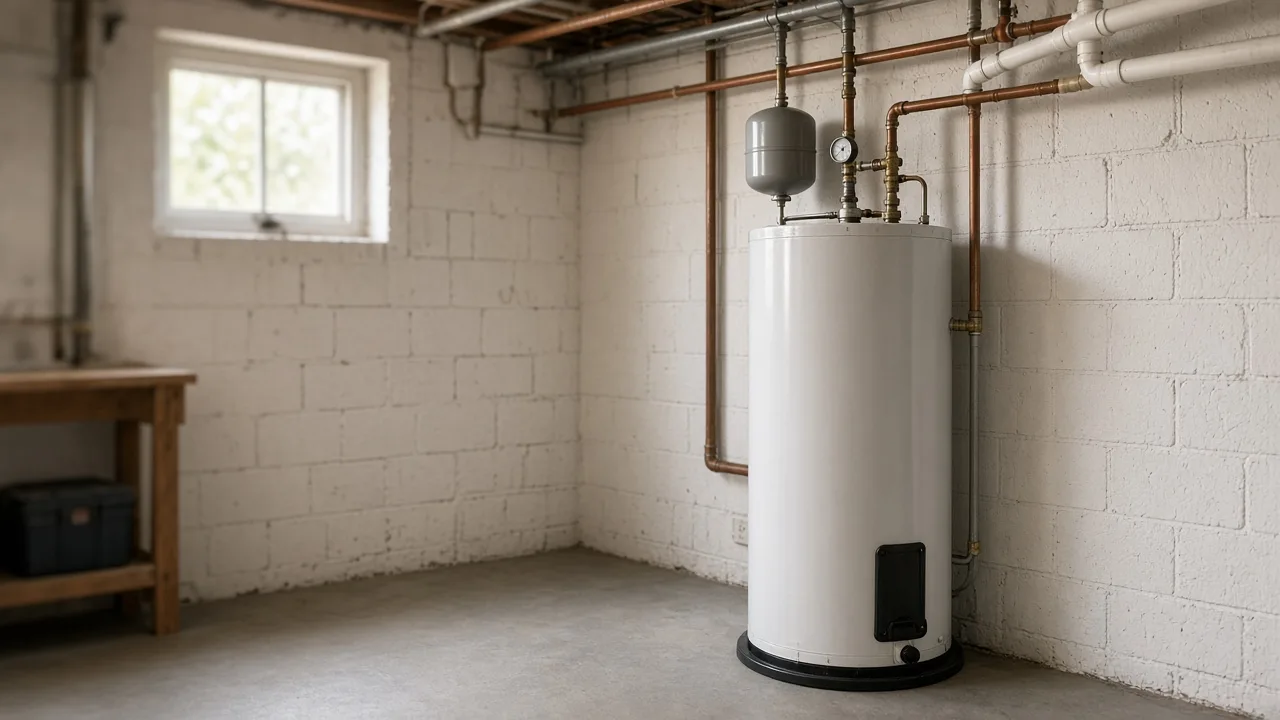
Most Cinnaminson homeowners never think about their water heater until the water turns cold mid-shower, and by then the decision has usually already been made for you: replacement, not repair. That is a shame, because the two things that shorten a water heater's life in this township are both known and both preventable. Cinnaminson's drinking water, drawn from the Delaware River and local aquifers by New Jersey American Water, measures hard, and hard water is exactly what kills tanks early. Here is how long a water heater should last in a Cinnaminson home, what maintenance actually matters, what a replacement costs in 2026, and when the upgrade to a tankless or heat pump unit is worth it.
How long does a water heater last in a Cinnaminson home?
Think of the 8-to-12-year number you hear quoted most often as the best case, not the promise. The U.S. Department of Energy estimates a conventional storage-tank water heater lasts 10 to 15 years, with gas units typically at the shorter end, around 8 to 12 years, and electric tanks stretching to 10 to 15. Tankless on-demand units last longer, commonly 15 to 20 years and sometimes beyond with regular maintenance.
Cinnaminson homes sit at the tougher end of that range because of water quality, more on that below. Research cited by the Water Quality Association found water heaters in hard-water areas can fail in as little as 6 years, while heaters on softened water kept factory efficiency for up to 15 years. Much of Cinnaminson's housing stock was built during the post-war era, with a median construction year around 1966, so a very large share of the tanks in this township are reaching or past the end of their design life right now. If you bought a home here in the last few years and never asked how old the water heater is, that is the first question to answer this weekend.
Why does Cinnaminson's water shorten a water heater's life?
Cinnaminson gets its drinking water from New Jersey American Water's Western Division, which draws from the Delaware River, the Potomac-Raritan-Magothy aquifer, and the Mount Laurel-Wenonah aquifer. The utility's 2025 water quality report measured total hardness at 128 milligrams per liter, about 7.5 grains per gallon, which the U.S. Geological Survey classifies as hard water, the 121 to 180 milligram range. Sewer service is separate, billed by the Cinnaminson Sewerage Authority, but the water itself is what matters for your tank.
Hard water means dissolved calcium and magnesium. When that water is heated, the minerals precipitate out of solution and settle as scale on the heating elements, the gas burner, and the bottom of the tank. Scale is an insulator, so the unit has to work harder to heat the same water: the Department of Energy estimates just a quarter-inch of scale can cut heating efficiency by 30 to 40 percent, and Pacific Northwest National Laboratory research found scale from hard water can cut a water heater's life by more than half. In practical terms, the same tank that might last 12 years on soft water often needs replacing at 7 or 8 in Cinnaminson. That makes maintenance more valuable here, not less.
How do you flush a water heater, and how often?
Once a year is the standard, and fall is the right time in South Jersey: flush the tank before the holidays, when hot water demand spikes with guests, laundry, and dishwashers all running at once. The flush itself is a 30-minute job. Turn off the power, the breaker for an electric unit or the gas valve to pilot for a gas unit, and shut off the cold-water supply. Attach a garden hose to the drain valve at the bottom of the tank and run the other end to a floor drain or outside. Open a hot water faucet upstairs to let air in, open the drain valve, and let the tank empty completely. Then close the drain valve, turn the supply back on, and let the tank refill before restoring power. Never run an electric unit dry, or the elements burn out. If the water that comes out is rusty or gritty, you have your answer about how overdue this was.
Three more checks belong on the same visit. Test the temperature and pressure relief valve, the small lever and discharge pipe on the side or top of the tank, once a year: lift the lever for a few seconds, confirm hot water flows, and let it snap shut. Have the sacrificial anode rod inspected every 3 to 5 years; on hard water, the rod corrodes instead of the tank, and replacing a $50 rod is far cheaper than replacing the tank. And if you are on the fence about doing any of it yourself, a licensed plumber can handle a flush, valve test, and rod check in a single service call. This routine pairs naturally with the cold-season prep in our fall home maintenance checklist, and the broader safety checks in our home safety checklist.
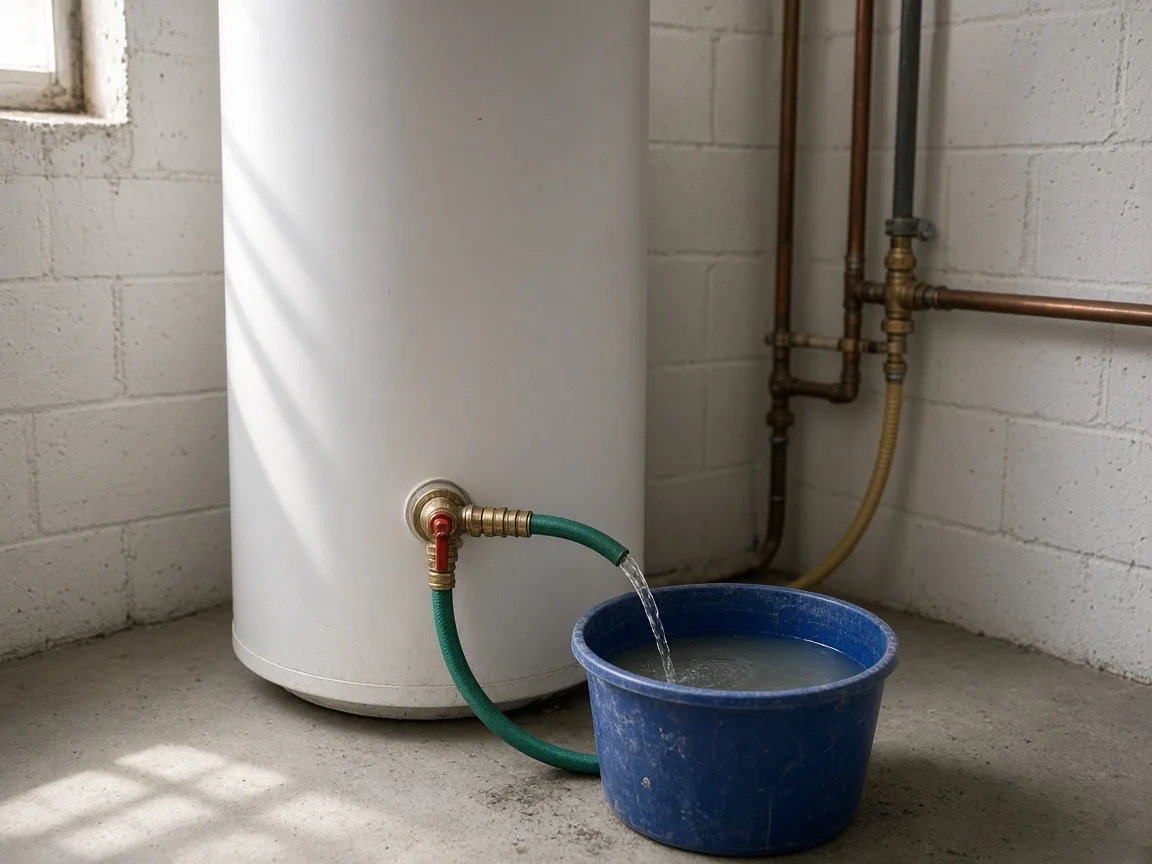
An annual flush is a 30-minute job with a garden hose. Gritty water coming out tells you the tank was overdue for attention.
What does a water heater replacement cost in 2026?
The short answer: expect roughly $900 to $1,800 for a standard tank replacement, and more if you switch to tankless. National data from Angi, based on tens of thousands of verified projects, puts the average installed water heater replacement at about $1,348 in 2026, with most homeowners paying between $881 and $1,826. A tank-style swap averages about $1,338, typically $882 to $1,816. A tankless replacement averages about $2,637, typically $1,405 to $3,899, and labor on a tankless install runs $600 to $1,900 because it usually means new venting, a gas line, or electrical work.
Permits add a small line item and a real compliance step. Cinnaminson requires a construction permit for a residential water heater replacement, handled under the mechanical subcode, and the township will not issue a permit without proof of contractor registration, so the unlicensed handyman special is not an option here. The plumbing subcode fee schedule in Township Code Chapter 265 runs about $13 per appliance connected to the plumbing or gas system, and your plumber should handle the permit and the inspection as part of the job. For the full picture of what these big-ticket replacements do to your annual upkeep, our home maintenance budget guide lays out the 1% rule and the other major systems.
Tank, tankless, or heat pump: which is right for a Cinnaminson home?
A standard 40- or 50-gallon tank is still the right answer for most Cinnaminson homes. It is the cheapest to replace, fits the footprint of the unit you already have, and a post-war basement has room for it. Gas tanks cost more to install than electric but are cheaper to run in New Jersey's gas-heavy market.
Tankless units buy you two things: an estimated 15 to 20 years of life, roughly twice a tank, and endless hot water. What they cost is upfront money and retrofit work. In an older Cinnaminson home, going tankless often means upsizing a gas line, new venting, or a dedicated electrical circuit, which is why the installed price runs $1,400 to $3,900. And hard water affects tankless units too: they need annual descaling, not just a flush.
Heat pump water heaters are the efficiency play. They use electricity to move heat rather than generate it, and they qualify for New Jersey efficiency incentives. They also need space and, in a cold basement, sometimes supplemental heat. If energy savings is your goal, start with our energy savings guide, which covers the 2026 rebate landscape in detail, and ask a plumber for a site-specific recommendation before you commit.
Does New Jersey require an expansion tank on a water heater?
Sometimes yes, and this is the code question that trips up DIY installers. New Jersey's plumbing code is the National Standard Plumbing Code, and NSPC 10.15.7 requires a thermal expansion control device whenever the water heater sits on a closed system, meaning there is a backflow preventer, a check valve, or a pressure-reducing valve on the supply line. If your house has a pressure regulator, and many Cinnaminson homes do, you need an expansion tank. Tankless, instantaneous water heaters are exempt.
An expansion tank is a small, inexpensive part, $40 to $100 for the tank itself, and about $150 to $450 installed on its own, averaging near $325 per Angi. When it is added during a water heater replacement, the cost is lower, typically $80 to $250. It is not optional decoration: on a closed system, heated water has nowhere to expand, and pressure spikes stress the tank, the relief valve, and your pipes. If your plumber says you do not need one, ask why, and if they say you do, say yes.
Where can Cinnaminson homeowners buy a water heater or hire a plumber?
Parts and tanks are close by. Harbor Freight at 2501 US-130 sits right in Cinnaminson for fittings and tools, and Home Depot at 9000 US-130 and Lowe's at 1331 Fairview Blvd, both just up the road in Delran, stock tanks, expansion tanks, and drain kits.
For the install itself, Cinnaminson has capable local plumbers who know the township's housing stock: The Friendly Plumber at 108 Wayne Dr, Wickersham Plumbing at 4 Kilmer Ct, and City Plumbing of South Jersey at the Madison Building on US-130 all work out of Cinnaminson, Wolfschmidt Plumbing, Heating & Cooling is on Broad St in nearby Riverton, and Eddie B. Plumbing is just across the line in Delran. Get two quotes, ask each whether the job includes the permit and the inspection, and confirm the contractor is registered with the State of New Jersey. A gas water heater is not the place to save $200 on an unlicensed install.
How does water heater care protect your home value?
Home inspections in Cinnaminson flag water heaters constantly, and it is one of the few inspection findings buyers actually negotiate over. A visibly maintained unit with a recent flush date, a working relief valve, and a reasonable age reads as a cared-for home, while a 14-year-old tank with sediment sounds and a seized valve reads as a $1,500 credit request. If you are selling, replacing an obviously aging unit before listing removes an objection and photographs better than a repair note in the disclosure. If you are buying, put "how old is the water heater?" on your question list; it tells you more about how the previous owner treated the house than almost any other single system. Our neighborhood guide can help you target the home styles and eras you will be shopping, from post-war ranches to newer construction at Poets Walk.
Water heaters in Cinnaminson: Your questions, answered
How long does a water heater last in a Cinnaminson home?
The Department of Energy estimates a conventional storage-tank heater lasts 10 to 15 years, with gas units typically at 8 to 12 and electric tanks at 10 to 15. Tankless units commonly last 15 to 20 years or more. Hard water shortens that, and research cited by the Water Quality Association found hard-water heaters can fail in as little as 6 years.
Why does Cinnaminson's hard water matter for water heaters?
New Jersey American Water's Western Division reported total hardness at 128 milligrams per liter, about 7.5 grains per gallon, in its 2025 report, which is hard on the USGS scale. Heated hard water leaves scale on the elements and burner, and the DOE estimates a quarter-inch of scale can cut efficiency by 30 to 40 percent. Scale can cut a tank's life by more than half.
How often should I flush my water heater?
Once a year, and fall is the right time before the holidays. Attach a hose to the drain valve, drain the tank completely, then refill before restoring power. Test the temperature and pressure relief valve on the same visit, and have the anode rod inspected every 3 to 5 years.
How much does a water heater replacement cost in 2026?
Angi's national average is about $1,348 installed, with most homeowners paying $881 to $1,826. A tank-style swap averages about $1,338, typically $882 to $1,816. A tankless replacement averages about $2,637, typically $1,405 to $3,899, with higher labor for new venting, gas line, or electrical work.
Does New Jersey require an expansion tank on a water heater?
Only on a closed system. New Jersey's plumbing code, the National Standard Plumbing Code, requires thermal expansion control under NSPC 10.15.7 when a backflow preventer, check valve, or pressure-reducing valve is on the supply line. Many Cinnaminson homes have a pressure regulator, so they need one. Tankless heaters are exempt.
Is a tankless water heater worth it in Cinnaminson?
Tankless units last roughly twice as long, commonly 15 to 20 years, and deliver endless hot water, but they cost $1,400 to $3,900 installed and often need a bigger gas line or new venting in older homes. Hard water means annual descaling. A standard 40- or 50-gallon tank is still the right answer for most homes here.
Do I need a permit to replace a water heater in Cinnaminson?
Yes. Cinnaminson requires a construction permit for a residential water heater replacement under the mechanical subcode, and the township will not issue permits without proof of contractor registration. The Chapter 265 fee schedule runs about $13 per appliance connected to the plumbing or gas system.
A neighborly reminder
I have walked basements all over this township, from the post-war ranches off Route 130 to the newer homes deeper in town, and the water heater is the system homeowners ignore until it fails at the worst possible moment, usually the week of Thanksgiving. The good news is the fix is cheap and fast: a 30-minute flush once a year, a relief valve test, and a straight answer on the unit's age. If you are buying, ask the age before you make an offer. If you are selling, fix the obvious unit before the inspector finds it. And if you just want a second set of eyes on a home's systems, I am here for that conversation too.
Have questions about Cinnaminson? Contact Bob Millaway at 856.426.1522
Contact Bob